

Lesson Summary
As to where Nested Elements will tie everything into one binding box, Nested Ranges refer to the application of using nesting to apply practical layers.
Full Transcript
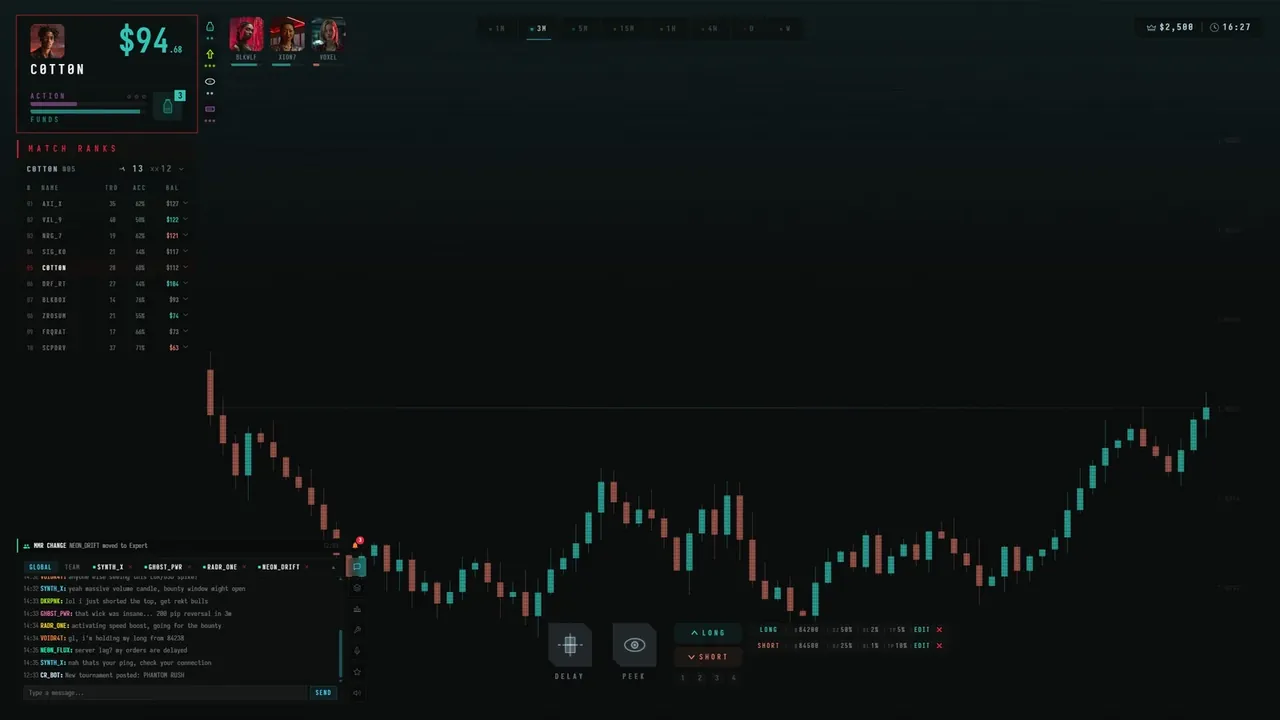
Nested Ranges is the operational implementation of Nested Elements. Where Nested Elements describes the theory, ranges inside ranges inside ranges, Nested Ranges is the practice of marking those ranges on a live chart and using them to understand current position and next targets. The shift from "Nested Elements" to "Nested Ranges" is the shift from conceptual understanding to active charting.
To mark Nested Ranges: start by identifying your master level, and build the architecture of the levels that have been hit inside the Combination Levels, and the ones that haven't. We want to see what levels have been tested inside this specific range, so that when the range protecting it loses its level, we can see what will hit inside our Nested Range. For example if we have a 4-hour Hold Level that is untested, and a 1-hour untested Combo Level, that leads into a 15-minute tested Hold Level: this will create a trail.
This 15-minute trail is tethered to the nested 4-hour timeframe. If the 15-minute trail exists, and we move multiple Ranges away, once that 15-minute trail breaks it pulls that level right back to the original 4H nested Range. This often creates large moves in the markets, and combines itself with +1/-1 as the next decision to see if the nested 4H level can hold inside the Nested Range. If the 1-hour Hold Level, that was above the original 15-minute Nested Level, holds, then your 4-hour level is holding, and you're still moving in the same direction as it is confirming its ladder.
Each Nested Range has a top and a bottom defined by the levels on its timeframe. The top of the one-hour nested range is a one-hour break or Hold Level. The bottom is another one-hour break or Hold Level. When price is inside this nested range, it is navigating between these two boundaries. When price breaks one of the boundaries, it exits that nested range and enters the corresponding level of the next outer nest.
The operational value of Nested Ranges is level clarity and range tethering. When you are inside the innermost active range, you know exactly where the targets are at each level of the nest: if you are inside a 1H candle, you see the 15-minute hold is stabilizing, and then you gain a 5-minute RAT and back test it as a Hold Level: you are being shown a 5-minute trail is trying to be created. Once you gain the hourly RAT you'll know to watch for 5-minute levels to become trails as it's tethered to the Range. When you know this, you can set targets with precision: the immediate target is the boundary that's tethered off the current innermost nest; the extended target is the boundary of the next outer nest.
Nested Ranges also clarify which levels to watch and which to ignore at any given moment. If you are inside the one-hour range, the daily levels at the outer nest are not immediately relevant to the current trade. They become relevant when the one-hour range breaks. Knowing which level of the nest is currently active keeps the analysis focused on what matters right now, without distraction from levels that belong to a different, outer context.
Disconnected timeframes break the nested range chain. If there are no one-hour levels within a four-hour range, meaning the one-hour structure has no untested levels between the four-hour boundaries, the nested range at the one-hour level is absent. In that case, you cannot use one-hour Combo Levels to refine entry to the four-hour level, because the one-hour nest does not exist in the connected chain. The entry goes directly to the next connected timeframe that does have valid levels within the range.
As Nested Ranges break one by one in the direction of the move, a trail forms. Each broken range boundary becomes a former resistance (or support) that price will back-test as it moves to the next nest. These back-tests are the moments of highest entry precision: price returns to a recently broken range boundary to confirm the break before continuing. Entering at a confirmed back-test of a broken nested range boundary is a structurally sound, logic-defined entry with clear trigger and shield logic defined by the structure of the range just broken.